EXPOSURE+ Mentoring Program is launched!

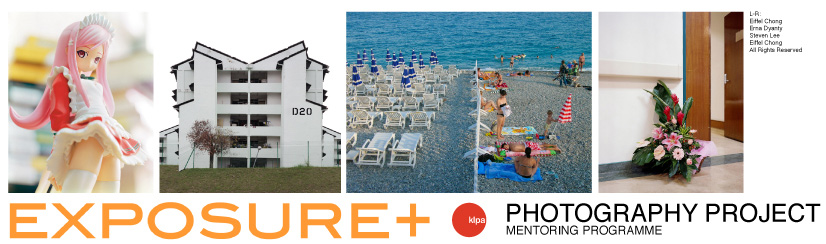
Following from our recent successful 1-Day workshops in collaboration with Le Meridien Kuala Lumpur, explorenation is proud to announce a pilot photography mentoring program in Kuala Lumpur, aimed at newcomers and experience photographers wishing to initiate their own personal projects. This is a time-based, 3 month long program where our mentors will assist and guide you in identifying stories, ideas or concepts that you can execute into a photography project, through to editing, sequencing and ultimately, creating a visually flowing and personally satisfying photo-book. You will also be invited to present your project in a brief talk at the Kuala Lumpur Convention Centre, in June 2013.  More below :
POSTER1

What is the Mentoring Program?

This is a 3-month ‘one-to-one’ photography mentoring program which begins from February – April 2013 in Kuala Lumpur. The program aims to assist photographers on

  • How to develop a strong and visually challenging photography project from concept to presentation
  • How to develop, identify and execute a cohesive body of work based on a concept
  • How to self-edit, sequence and present your own project images
  • How to put together a portfolio for effective presentation


How will this be accomplished?

Through several regular one-to-one constructive critique review sessions with our facilitators –
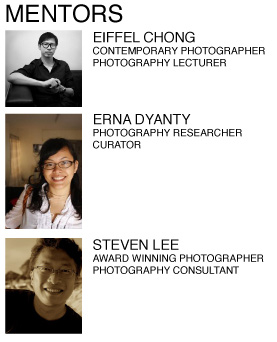
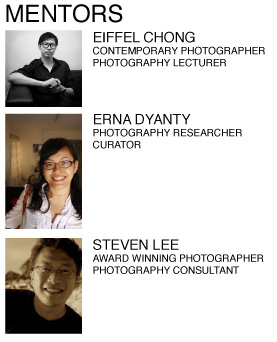
Eiffel Chong – contemporary photographer/lecturer
Erna Dyanty –  photography researcher/curator
Steven V-L Lee – freelance photographer (* online interaction only)

Suitability?

This program is open to novice, serious hobbyists and professional photographers who are seeking to develop their skills in producing personal photography projects, and may benefit from guided mentoring through greater focus in developing concepts from ideas, seeing it to fruition in a personal photobook. You will be required to be dedicated and fully resigned to completing this program in the time allocated.

How do I apply?

Interested photographers will have to send in a project proposal with a short statement why you wish to participate in this program.  The projects proposed can be based on documentary or fine art, but may only be general ideas at this stage. Describe briefly your intent on realising this project, ie. why you think it is a worthwhile project.  There will be a limited number of participants.

Photographers will need to have basic photography skills and camera techniques as this is not a technical workshop. Facilitators will not specifically teach image editing or other technical photography skills.

Application opens December 31, 2012 and closes January 9, 2013 and will be on ‘first come’ basis. There will be limited entries. 

Participants will be notified of their mentor based on the relevancy of their project, and of the first session by February 1, 2013.

Send in your details as follow, to erna@klphotoawards.com or +60 12 231 0961

Name
Email contact
Telephone contact
Website (if any)
Project statement (please state overall ideas and concept, interests )

Is this a paid workshop and what is included?

Program Fee –  RM650, which includes

  • Regular one-to-one mentoring over three month through direct contact with facilitators. There will be a meet-up session every fortnight to assess progress and discuss your project.
  • A brief tutorial on how to put together a portfolio photobook.
  • An A4 photobook, of your project put together by you for your personal keeping.
  • 5 x A4 photo prints that will be exhibited by EXPOSURE + in conjunction with KL International Photoawards Finalists Exhibition in June 2013 at the Kuala Lumpur Convention Centre.
  • An invitation to present your completed project to an audience during the public exhibition at the KLPA Talk Series in June 2013
  • You will also join the Alumni of explorenation.net and participate in their future events.


About our Mentors 
POSTER2

Eiffel Chong

Eiffel Chong graduated with an MA in International Contemporary Art and Design Practice from the University of East London. He is currently a photography lecturer at an art institution in Malaysia. Chong has been featured in numerous exhibitions in Malaysia and around the world. Among the exhibitions are: Silent Auction at London College of Communication, London, 2008; A New Wave of Responsive Images at Nikon Ginza Gallery, Tokyo, 2009; and CUT2010: Parallel Universe, which toured Southeast Asia, showing at Valentine Willie Fine Art Kuala Lumpur & Singapore, Sangkring Art Space, Jogjakarta and Manila Contemporary, Philippines. Chong has participated in the Singapore International Photography Festival 2008, Lasalle College of the Arts, Singapore.
http://www.eiffelchong.com

Erna Dyanty

Erna Dyanty graduated with an MA in Arts Management from UKM. She is a self taught photographer and is a practicing contemporary art photography.  She was nominated to participate in the Asian Europe Foundation Emerging Photographers Forum in 2009. Her works have been featured in CUT 2008: A Survey of New Photography in South East Asia, Kuala Lumpur,  A New Wave of Responsive Images at Nikon Ginza Gallery, Tokyo, 2009; Theerta International Women Photography Exhibition, Colombo, Sri Lanka, 2011 and DATUM KL in 2011.

Erna has also worked creatively to produce photographic works for Frangipani Bar & Restaurant, Alexis Bistro, Concorde Hotel and Dwell Asia Magazine. She has also curated a number of photography exhibitions in Kuala Lumpur, Vision & Sound: a survey of underground music photographers, MAP KL, 2010, ROCK KAKA, at Project Room VWFA 2009, Neither East nor West: Collections from the Lafayette Studio of Photography London, Islamic Arts Museum Malaysia, 2007 and The Formation of A Nation: A Photographic Flashback, Islamic Arts Museum Malaysia, 2012.

Steven V-L Lee

Steven Lee began his photographic career as a documentary and travel photographer in the late 90’s when began writing travel related articles for magazines and journals. In 2000, he published his first coffee-table book titled Outside Looking In : Kuala Lumpur, which received the Asian Prize at Photo City Sagamihara Festival of the Image, Japan in 2007. Part of the collection is held with the City of Sagamihara National Photographic Archives.
His commercial portraiture and fashion work has graced the covers of License! Europe, Country Club UK and Masterpiece and Asiana magazines. In 2008, Steven was involved in portfolio reviews at Cultivate, a Rhubarb-Rhubarb initiative for graduates in Photography, to prepare and guide them in portfolio preparation and exhibitions.

In 2009, Steven initiated the KL PHOTOAWARDS, an annual international portrait photography competition centred in Malaysia, focussing on the best in contemporary portrait photography and has attracted the participation of some top international photographers. Steven also blogs at explorenation.net and has run workshops at Lim Kok Wing University London, in Kuala Lumpur as well as travel tours.
http://www.stevenleephotography.com


EXPOSURE+
is explorenation’s new photography program which is formulated to encourage members to get involve and participate in regular meet ups, exhibitions, present new work, network with other photographers and enthusiasts, and have fun! Our first event was a SlideShare evening on Tuesday 24th July at the French Art Gallery in London. Since then we have had a total of three SlideShare evenings in 2012.

EXPOSURE+ now has a Malaysian chapter! Starting in February 2013, we will be running a 3-month pilot Photography Project Mentoring Program.

‘Photography for All’
explorenation.net runs travel photography, publishing, exhibition, photography education and workshops. Started by Steven V-L Lee, an award winning UK based freelance photographer and Andy Craggs in 2008, explorenation.net is dedicated to the personal advancement of photographic objectives for all enthusiasts. We believe in the universal language of the ‘photograph’ and that photography should be accessible to everyone, and continue to break the elitism that plagues so many aspects of contemporary practice. explorenation.net also project manages the annual KL International Photoawards for contemporary portraiture.

Please email us if you are interested in joining our workshops and become Alumni.
http://www.explorenation.net


Contact info
Erna Dyanty    erna@klphotoawards.com  +60 12 231 0961

So This Is Christmas, in Malaysia

DSCF1573

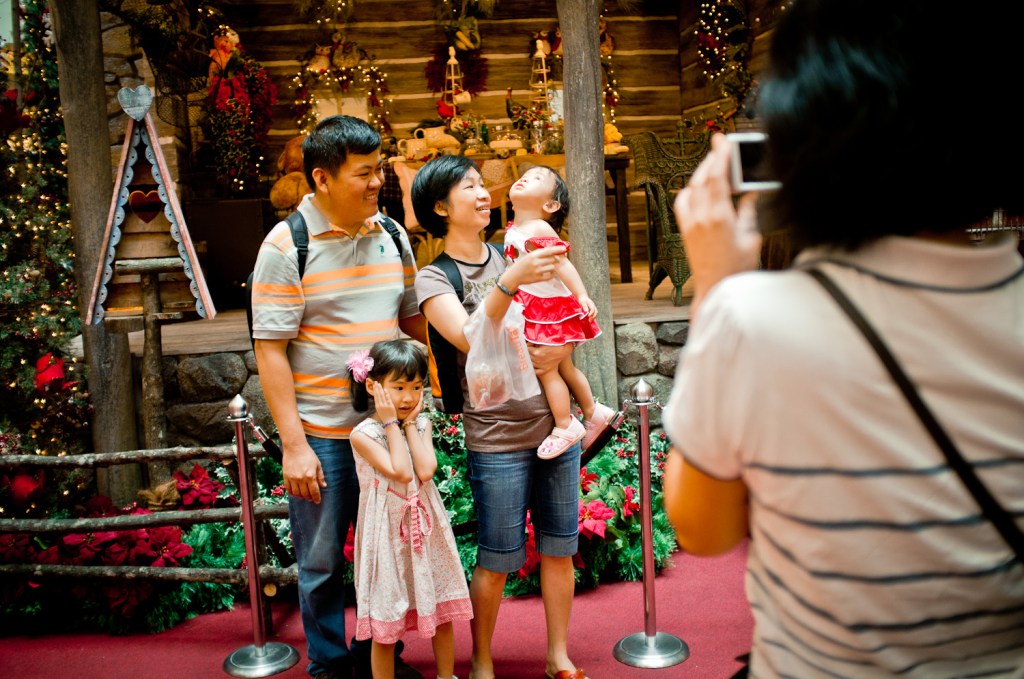
I came away from the Mid Valley mall, one of the largest shopping malls in Malaysia, located in Kuala Lumpur, with some photographs in the video. Being the second last weekend before Christmas Day, the shops were teeming with shoppers, look-seers, families, locals and tourists alike. As usual, the central atrium is richly decorated with giant conifers adorned with all Christmassy trimmings, flashy lights, fake snow, icicles, silver globes and golden bells. This year, there are two log and stone cabins built on the set to attract visitors, and I think they do look pretty realistic, compared to yesteryears, where these were usually painted scenes on flat plywood and styrofoam. Today, set designs have improved by leaps and bounds, the renderings authentic, and the animals are, at last, to scale with everything else.

I guess for kids, these sights can be a bewilderment and awe, as quite often they recollect similar scenes from fantasy or Hollywood movies watched over the years. No Santa here, sadly.

(PS. Sorry about the cheesy tune)

Greetings from Burma, Kuala Lumpur

I had been busy this trip to Kuala Lumpur, not having gone walking with camera in hand at all. Having been stuck behind a monitor for 2 & 1/2 weeks day in and day out meant I was longing to go make some pictures. 30 minutes was the time I had to spare between my last minute appointments today, and so I headed off to Little Burma, in and around ‘old’ KL town centre. The streets covered were Leboh Pudu, Lorong Pudu, Jalan Yap Ah Loy and Medan Pasar, all adjacent to Central Market.

This slideshow requires JavaScript.

If you don’t like crowds, don’t come here on a Sunday, as then, these roads will be teeming men from Myanmar, Bangladesh and other neighbouring nations, plus Africans and a smattering of Western tourists. Not many locals. They will be wandering aimlessly in modern shopping malls. Being a weekday today, it is considerably quiet, and some pockets of men loitering with intent outside mobile phone shops, or money transfer agencies. A verbal fight between two men just started as I walked by a storefront. One had just verbally abused the other, and started to kick him, several men gathered to calm things down.  I walked by.

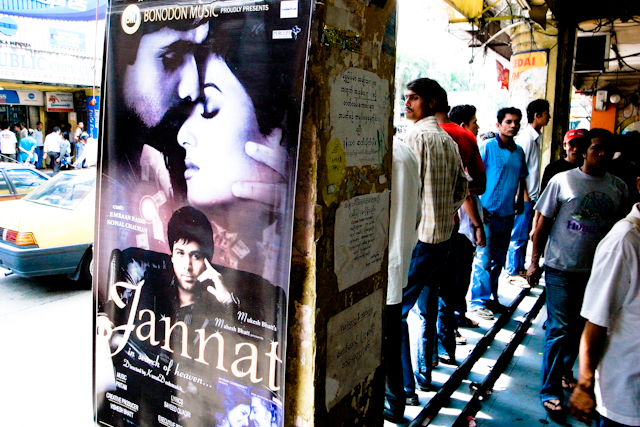
There are supermarkets selling all manner of groceries imported from the subcontinent, magazines, DVDs, CDs and newspapers in Burmese language, and wall paintings and signage daubed on the walls advertising mobile phones to nasi goreng. Interesting. Just wished I learnt some Burmese, or Myanmarese? One thing I noticed was that the Burmese, like many people love Bollywood action movies. But don’t we all.

So many streets, so little time

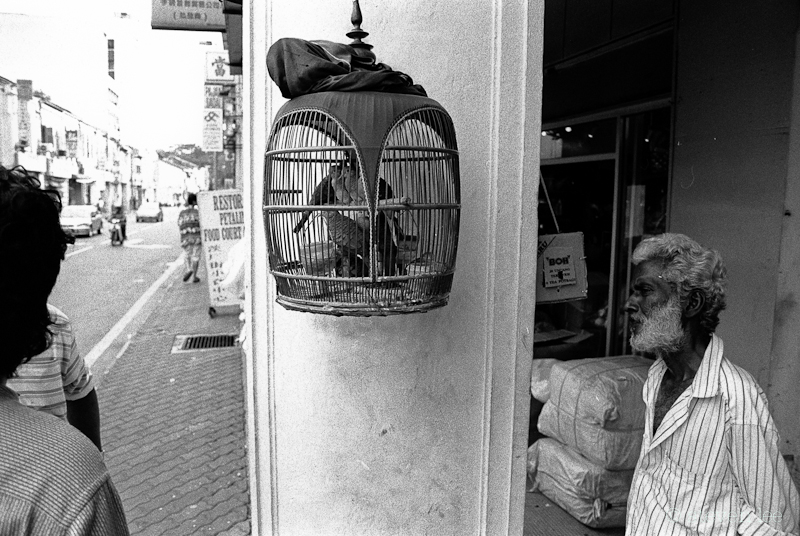
Free as a caged bird, Jalan Sultan 1999 © S Lee

The subject so many photographers are talking about nowadays, Street Photography. It used to be Wedding Photography several years ago. Anyone worth his or her DSLR (newly purchased, of course) shot weddings and events. Make a few bob, while totally undercutting the established pros. Clients are dumbfounded, none the wiser as to why pro wedding photographers charge the earth when Mr Shiny DSLR can do the same for a few hundred bucks. Not.

Fast forward to 2010/2011, and suddenly, sea of change. Now, everybody is gun-toting their rangefinder boxes and shooting covertly like a grandmaster in the lorongs, jalan-jalans, sidewalks, markets, train stations, underpasses, flyovers, whatever. Trying to capture that elusive ‘moment’ where ‘mind meets heart’ and trigger fingers at the ready. Is this just another passing fad, until the next great genre comes along, like the ‘European-style-barren-landscape-and-derelict-block-of-flats’ genre perhaps. Or maybe the ‘Shoot-my-cool-and-drugged-out-party-friends-genre’? Whatever the motive for photographing in the streets, one thing’s for sure. It isn’t easy at the best of times.

Street photography requires lots of patience and stamina. Lot’s of walking, and talking, and research. The reason I am writing is that recently, there has been much controversy concerning the proposed acquisition and demolition of about 30 shop units along Jalan Sultan and Petaling in KL’s Chinatown. These properties have been there for well over a century, being the spot where the city of Kuala Lumpur was founded and established a trading centre by early settlers. The government has plans to build a MRT station nearby and so tunneling is expected below. The shop owners are protesting against the acquisition on the grounds that these are heritage buildings, and tunneling happens, usually, below ground. There should be no need to acquire the surface buildings.

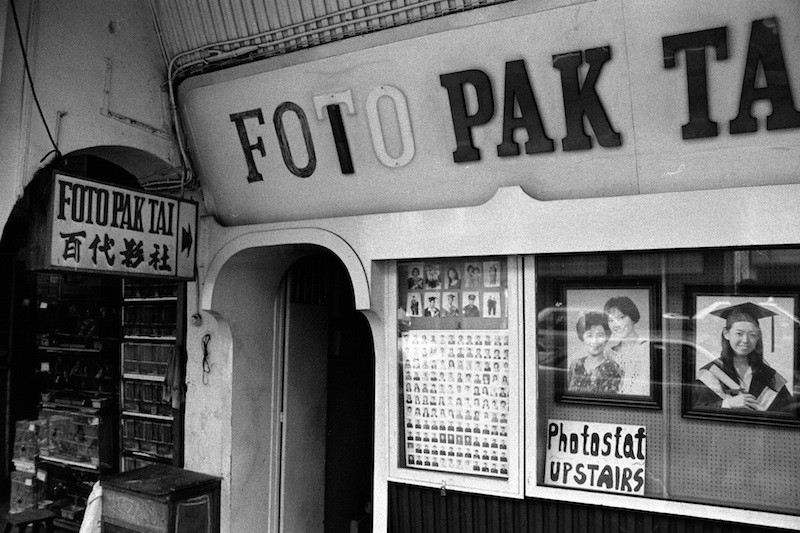
Foto Pak Tai studio, Jalan Sultan, 1999 © S Lee

In 2000, I published a book of street photographs of the area titled Outside Looking In : Kuala Lumpur* and was recently approached by one of the representatives of the Jalan Sultan traders if I could support their cause by lending some of the images to be used to highlight the importance of our heritage areas. I gladly and unreservedly obliged providing I have suitable images. I subsequently dug out my archive of black and white negativess to rescan whatever photographs I see fit to use. Most were shot in 1998 – 2000 and I must have made at least 20 trips to the Chinatown streets over those years.

The intention at that time was to document the street activities, trades and people that live and work in the area. They weren’t cool or arty ‘juxtapositions’ of unguarded moments between light and shadows. They were just plain snaps of the streets, by today’s standards. However, they had a value. With the passing of time, everything has a value.  I knew then, that one day, the area will be redeveloped or buildings would come down and new ones replace them. People come and go. Petaling Street has now changed so much, it is unrecognisable. The horrendous wave-form roof structure transformed a bustling random outdoor street market into something of a tacky covered mall with terrible airflow, and cast a deathly greenish tint below. (Does wonders for the White Balance function).

Gateway to Chinatown, Petaling Street 1999 © S Lee

Thankfully, major redevelopment has not taken place, and although some shophouses were demolished along Jalan Sultan due to fire, the atmosphere of Chinatown has changed little. That is how visitors want to experience it. That is how the local shopkeepers want to keep it. This area of the City is the most visited part of Kuala Lumpur after the Petronas Twin Towers and should at least be preserved as the city’s heritage and history area, and any redevelopment should be resisted.

Setting up, Jalan Sultan 1999 © S Lee

Looking through the contact sheets again after more than a decade, brings back the memories of my jaunts in the alleys and my encounters with the people there. Chinatown is one place where it is nigh impossible to make street portraits of the traders and the old men that sit on the sidewalk playing chequers. For some reason, they are all shy of a lens pointed at them. Nevertheless, some of my best personal street photographs had been taken during these early years. For me, a ‘good’ photograph allows the viewer to question the content, probe and find answers. It ought to have layers of context and sub text that defines being human. It should include all the hallmarks of a mini-drama which may be read, ie, a narrative.

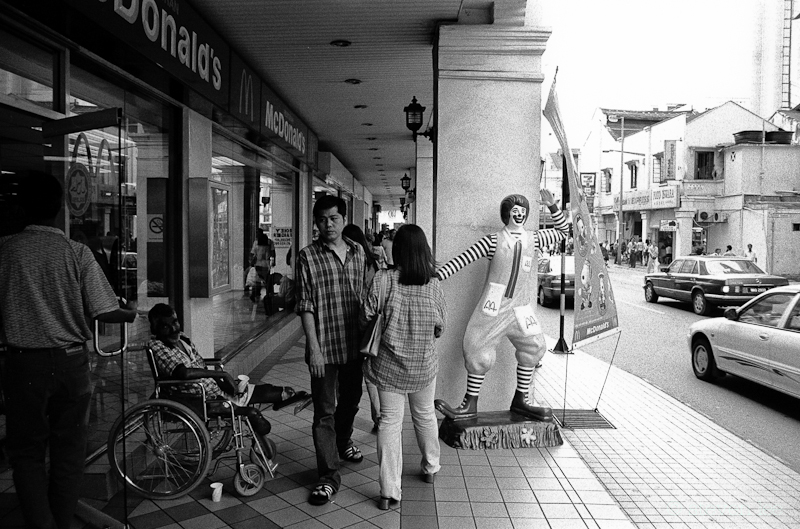
‘Ronald directs sympathy at a double amputee with fixed plastic cheer’ Jalan Sultan 1999 © S Lee

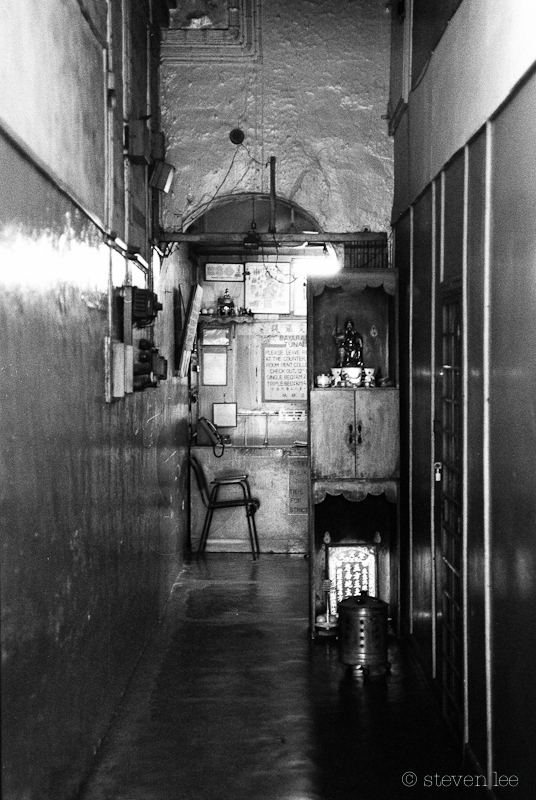
Reception, Hotel Leng Nam, Jalan Tun H S Lee 1999 © S Lee

Coming back to my original topic of this piece, street photography. I realise that for any serious project on the street, one must have an intention, and an executable one at that. Most photography done on the street are social documents.  Even if you have a penchant for street furniture, street portraits, or making architectural studies, it is about making a document of the social conditions, the environment and situation which surrounds us. So, in most respects, it must include the ‘players.’  These are the people that live there, work there, and visitors. What are they doing? Why are they there? These are some questions that can assist in your approach.

Bangladeshi immigrants hanging out in Leboh Pudu on a Sunday, Kuala Lumpur 2008 © S Lee

Today, I still photograph this area of Kuala Lumpur and make a point to head downtown whenever I visit Malaysia, making another documentation of images in colour, which is the medium I shoot nowadays.  The combination of various cultures, mixing of local and immigrants, the ethnic-based stores and trinket stalls make it a colourful and fascinating place to photograph.

Nepalese gemstone traders, Petaling Street, Kuala Lumpur 2009 © S Lee

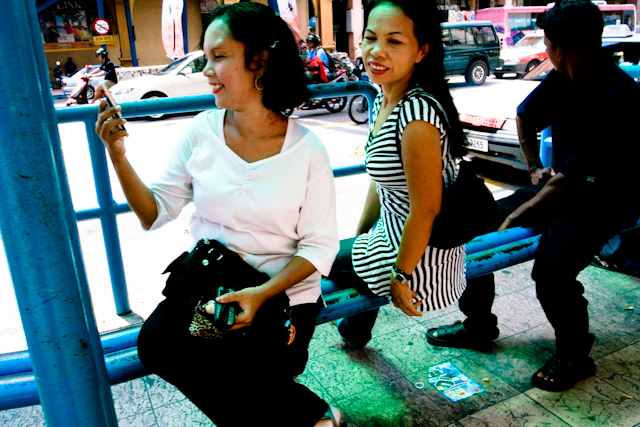
Filipinas waiting for a bus, Kota Raya, Kuala Lumpur 2008 © S Lee

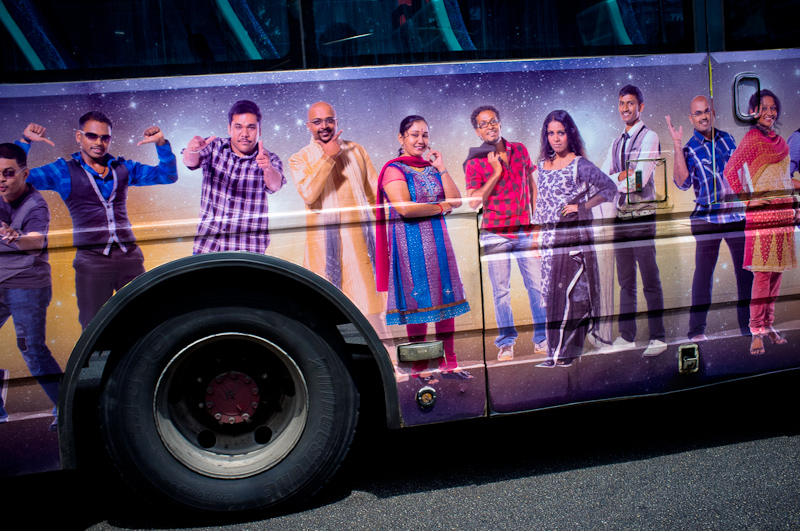
10 years on and the landscape is changing. Old KL is now a haven for the immigrant population. Bangladeshis, Nepalese, Cambodian and Filipino workers have pretty much taken over the streets of Central KL, as the more affluent locals congregate towards the Golden Triangle, KLCC and MidValley. Socially speaking, it is interesting times. Weekends present the best time for street photography. Chinatown and its surrounding streets turn into Little Nepal. I like this. Its makes for a multinational city with soul, rather than a superficially glossed-over pristine bubble.

Note :

* Outside Looking In : Kuala Lumpur

I have some limited copies of this book available to anyone who wants one, you just need to drop by to a PJ address to collect it, complimentary. Email me at svllee@gmail.com