
French Flair #2

See French Flair #1
See French Flair #1

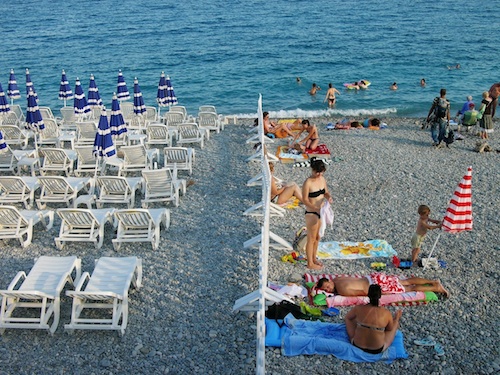
© Steven Lee 2011
This year’s AOP Open Awards Exhibition, Presentation and Party will be taking place at The Dray Walk Gallery in London’s vibrant Truman Brewery.
My entry here is in the shortlist and will be exhibited and included in the accompanying catalogue. It was taken in Nice earlier this year, from my series ‘Azuristic’, documenting the tourism industry of the Mediterranean coast.
The Exhibition also falls within East London’s Photomonth and will be open to the public on the 14-16 October Friday 11-8pm, Saturday & Sunday 10am-6pm. The Private View is taking place on Thursday the 13th October.
The AOP Open is RSVP only!

 © Laura El-Tantawy 2011
In the Shadow of the Pyramids is Laura El-Tantawy’s current project documenting Egypt’s popular uprising. Her Artist Talk yesterday evening at the Green Cardamom Light Gallery was informative and totally engrossing and drew a small crowd of interested audience. Egypt is experiencing a change that is unprecedented in the modern historical context. As an Egyptian and living in the UK, she is determined that her work be seen by Egyptians in Egypt. That is her ‘end game’ to this current project. And a book.
Ultimately, though, she would love to be able to display her powerful and moving photographs in Tahrir Square one day, and invite the people of the revolution to see them at “Ground Zero’ as it were. Liberation Square as it is also known, was the hallowed ground on where the Cairenes gathered in their thousands to over several weeks prior to the ousting of the president. It was also the place where they celebrated with street parties after Mubarak’s resignation.
 © Laura El-Tantawy 2011
For me, Egypt has also carved a significant moment in my life.
At 8:45am on 17, November 1997, 58 foreign tourists and 4 Egyptians were brutally massacred by terrorists at the entrance to the Temple of Queen Hapshetsut, Valley of the Queens in Luxor. This was a dark day for Egypt. My parents, aunt and I were with a group, about to enter the Valleys at about 8:30 am led by our tour guide. Usually, the guide would lead the bus driver pass the ticket office and straight to the Valley of the Queens first, being the closer of the two Valleys. That fateful morning, our guide decided to head for the Valley of the Kings instead. Had he stuck to his routine, our bus would have arrived right at the moment when the attack took place. The two Valleys are separated by a hillock. We were fortunate. Not so, for a South American couple who shared our dining table on the Nile boat. They joined another tour group and left earlier that morning.
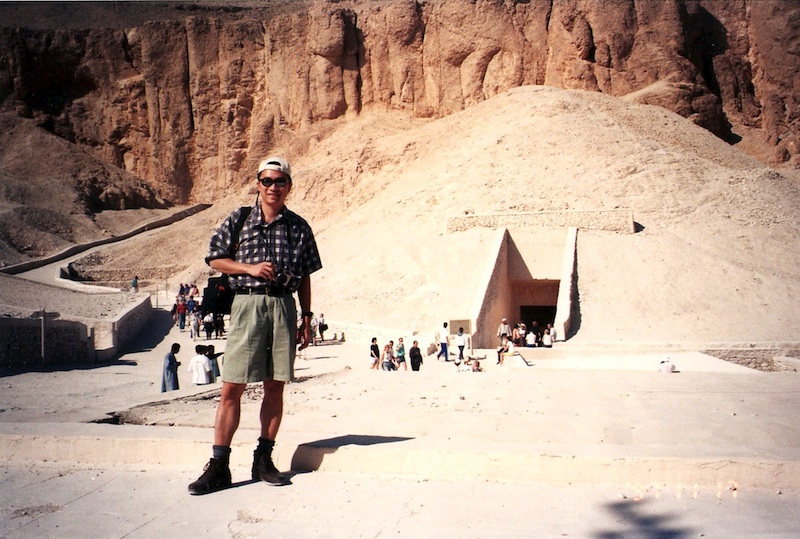 Myself, taken by my aunt outside KV7, Tomb of Ramses II, Luxor, approx. 9:00 am, 17 November 1997
My discovery tour to Egypt ended abruptly the next day as I was ‘forced’ to fly home via Cairo, ordered by my better half, who read the headline news on the Evening Standard in the London underground. My discovery of Egypt is thus incomplete, and what better way than to make a return to the Land of the Pharoahs, a historical Biblical land to so many, and a nation that is in transition.
Thank you to Laura who’s work peeked my curiosity once again to visit Egypt, and thank you to all those that attended explorenation’s inaugural Artist Talk.
—
See also here.
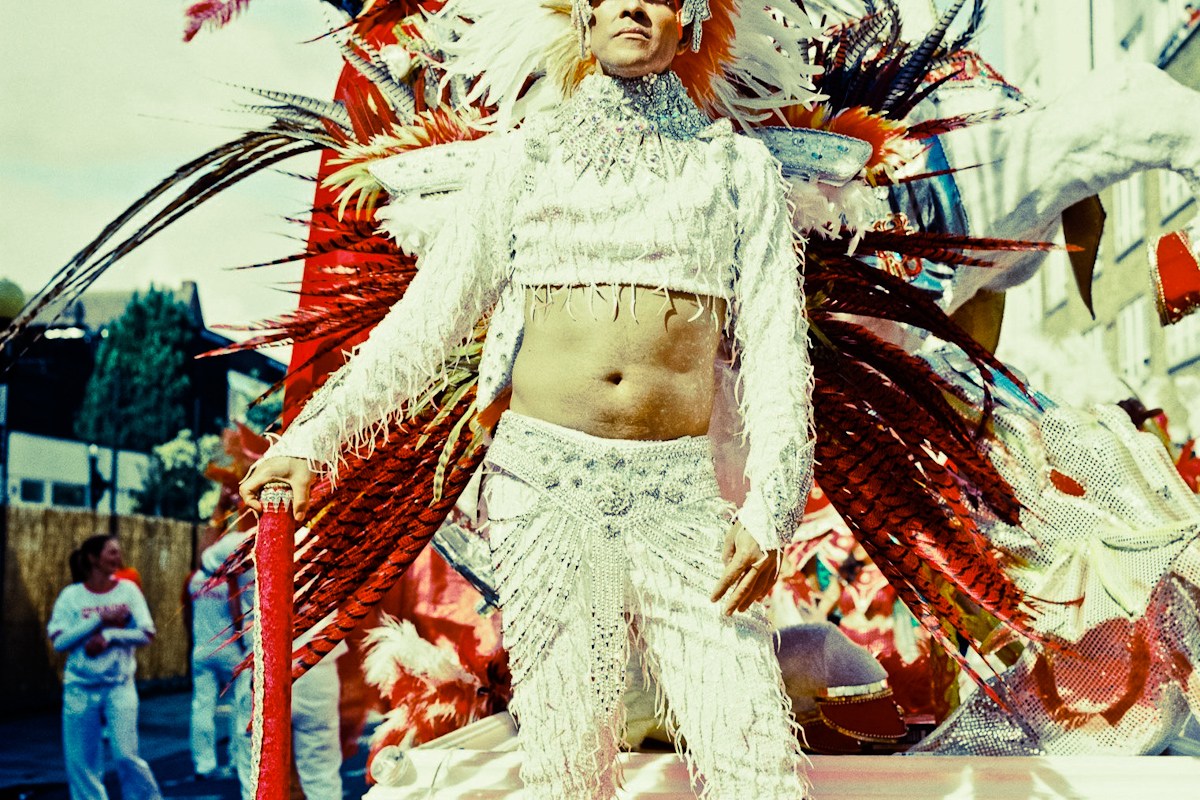
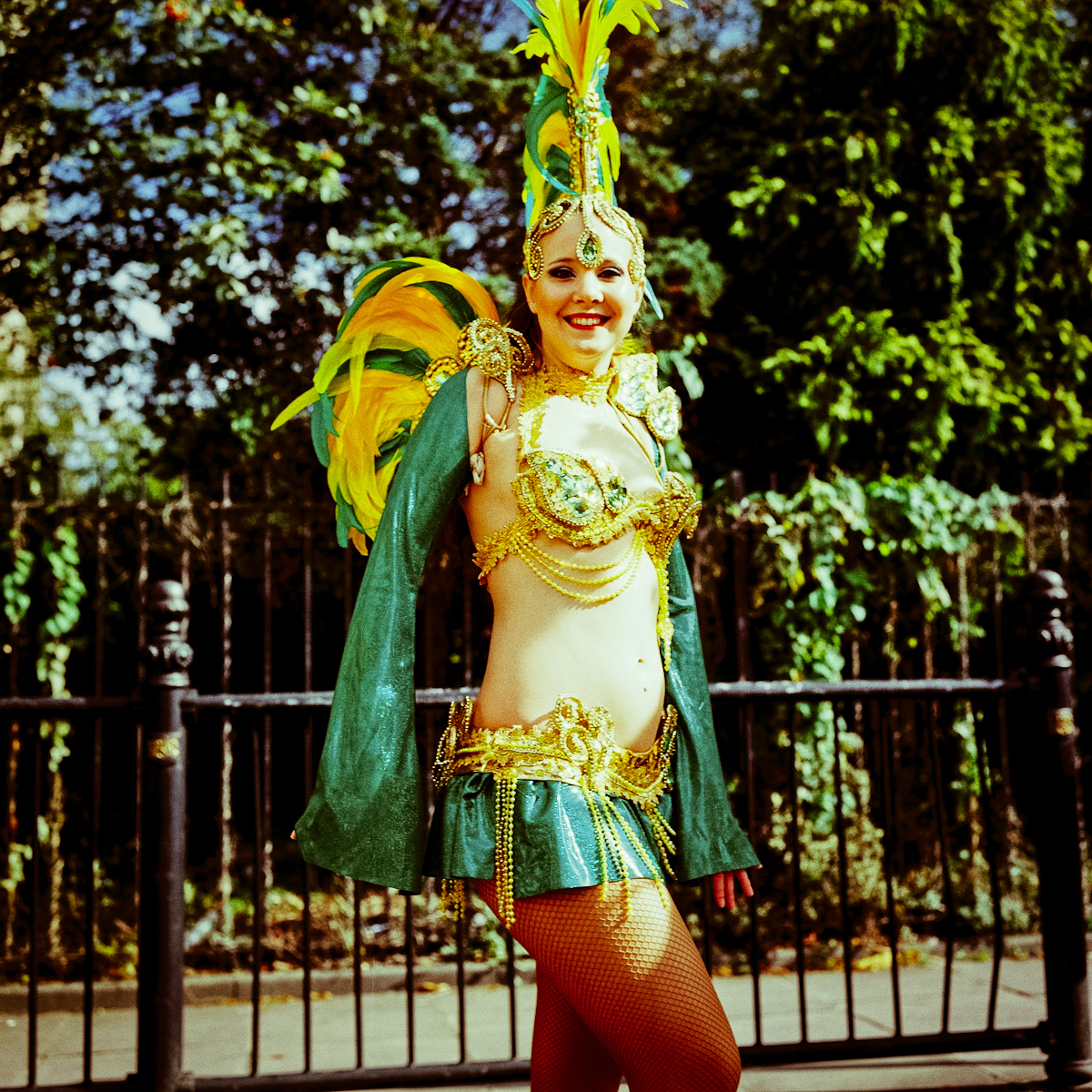
I brought along my trusty Rolleiflex 3.5 and several rolls of Lomography 120 film to the Notting Hill Carnival recently and just picked the scans up from the friendly Lomography store in London’s Carnaby Street. I had been trying out their Red Scale 120 films. This is a 200 ISO rated film which has been reverse wound onto the spool. Exposing it at 200 will result in a red and orange tint, whilst giving it more exposure (rating it from 50 to 100 ISO) will result in green or blue tints, depending on the quality of light. It’s a hit and miss result, so there’s no hard and fast rule about your exposure. I guess that it the charm about shooting ‘Lomo’ style pictures. You just don’t know what you are going to get. I like the organic quality of film, the grain and the cross-processed look, which is done chemically rather than through Apps or digital filters.

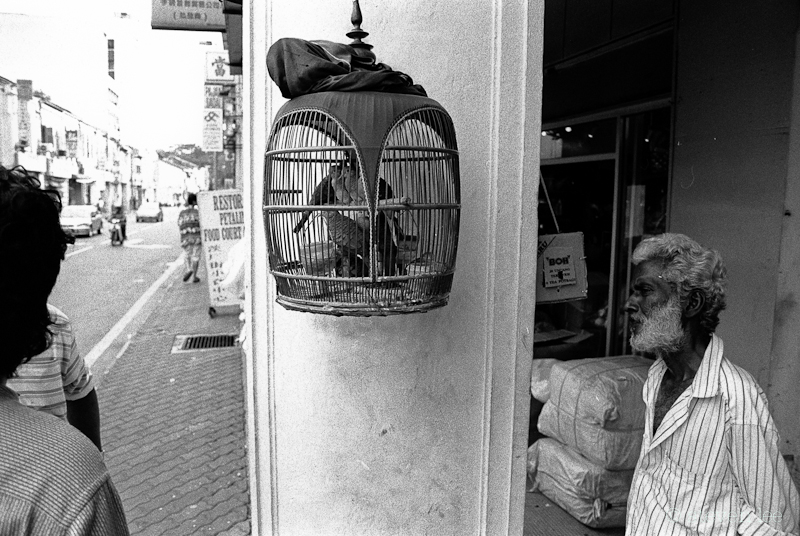 Free as a caged bird, Jalan Sultan 1999 © S Lee
The subject so many photographers are talking about nowadays, Street Photography. It used to be Wedding Photography several years ago. Anyone worth his or her DSLR (newly purchased, of course) shot weddings and events. Make a few bob, while totally undercutting the established pros. Clients are dumbfounded, none the wiser as to why pro wedding photographers charge the earth when Mr Shiny DSLR can do the same for a few hundred bucks. Not.
Fast forward to 2010/2011, and suddenly, sea of change. Now, everybody is gun-toting their rangefinder boxes and shooting covertly like a grandmaster in the lorongs, jalan-jalans, sidewalks, markets, train stations, underpasses, flyovers, whatever. Trying to capture that elusive ‘moment’ where ‘mind meets heart’ and trigger fingers at the ready. Is this just another passing fad, until the next great genre comes along, like the ‘European-style-barren-landscape-and-derelict-block-of-flats’ genre perhaps. Or maybe the ‘Shoot-my-cool-and-drugged-out-party-friends-genre’? Whatever the motive for photographing in the streets, one thing’s for sure. It isn’t easy at the best of times.
Street photography requires lots of patience and stamina. Lot’s of walking, and talking, and research. The reason I am writing is that recently, there has been much controversy concerning the proposed acquisition and demolition of about 30 shop units along Jalan Sultan and Petaling in KL’s Chinatown. These properties have been there for well over a century, being the spot where the city of Kuala Lumpur was founded and established a trading centre by early settlers. The government has plans to build a MRT station nearby and so tunneling is expected below. The shop owners are protesting against the acquisition on the grounds that these are heritage buildings, and tunneling happens, usually, below ground. There should be no need to acquire the surface buildings.
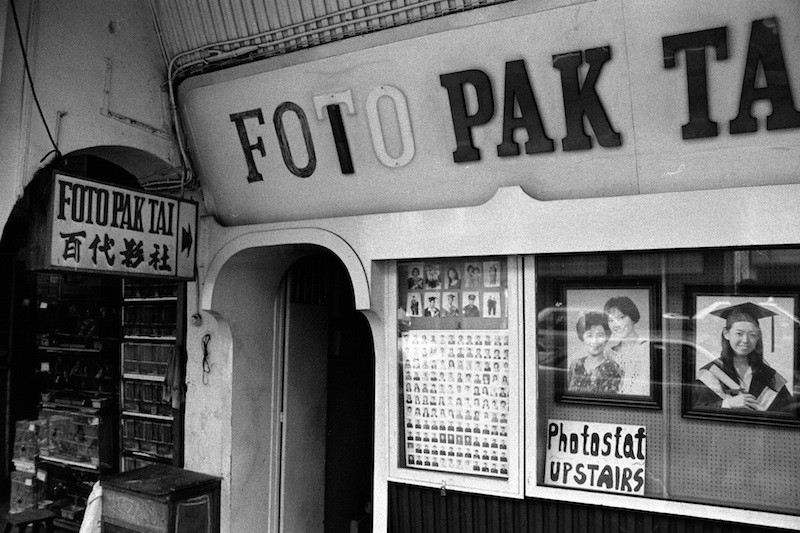 Foto Pak Tai studio, Jalan Sultan, 1999 © S Lee
In 2000, I published a book of street photographs of the area titled Outside Looking In : Kuala Lumpur* and was recently approached by one of the representatives of the Jalan Sultan traders if I could support their cause by lending some of the images to be used to highlight the importance of our heritage areas. I gladly and unreservedly obliged providing I have suitable images. I subsequently dug out my archive of black and white negativess to rescan whatever photographs I see fit to use. Most were shot in 1998 – 2000 and I must have made at least 20 trips to the Chinatown streets over those years.
The intention at that time was to document the street activities, trades and people that live and work in the area. They weren’t cool or arty ‘juxtapositions’ of unguarded moments between light and shadows. They were just plain snaps of the streets, by today’s standards. However, they had a value. With the passing of time, everything has a value. I knew then, that one day, the area will be redeveloped or buildings would come down and new ones replace them. People come and go. Petaling Street has now changed so much, it is unrecognisable. The horrendous wave-form roof structure transformed a bustling random outdoor street market into something of a tacky covered mall with terrible airflow, and cast a deathly greenish tint below. (Does wonders for the White Balance function).
 Gateway to Chinatown, Petaling Street 1999 © S Lee
Thankfully, major redevelopment has not taken place, and although some shophouses were demolished along Jalan Sultan due to fire, the atmosphere of Chinatown has changed little. That is how visitors want to experience it. That is how the local shopkeepers want to keep it. This area of the City is the most visited part of Kuala Lumpur after the Petronas Twin Towers and should at least be preserved as the city’s heritage and history area, and any redevelopment should be resisted.
 Setting up, Jalan Sultan 1999 © S Lee
Looking through the contact sheets again after more than a decade, brings back the memories of my jaunts in the alleys and my encounters with the people there. Chinatown is one place where it is nigh impossible to make street portraits of the traders and the old men that sit on the sidewalk playing chequers. For some reason, they are all shy of a lens pointed at them. Nevertheless, some of my best personal street photographs had been taken during these early years. For me, a ‘good’ photograph allows the viewer to question the content, probe and find answers. It ought to have layers of context and sub text that defines being human. It should include all the hallmarks of a mini-drama which may be read, ie, a narrative.
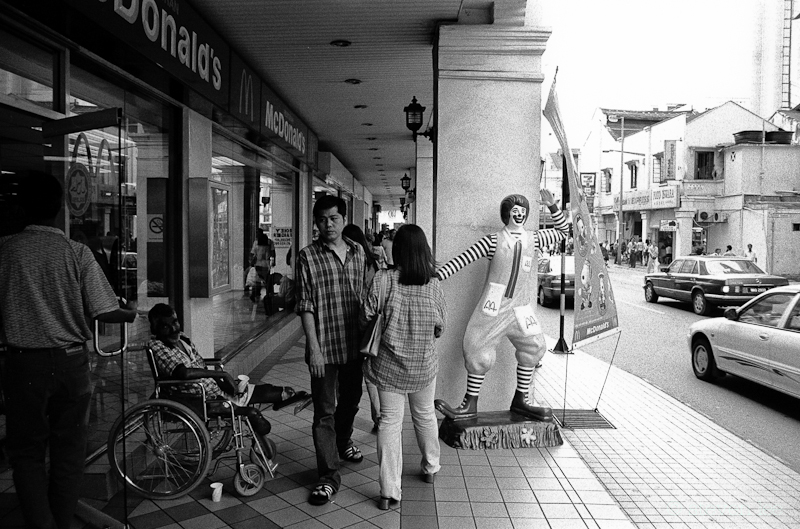 ‘Ronald directs sympathy at a double amputee with fixed plastic cheer’ Jalan Sultan 1999 © S Lee
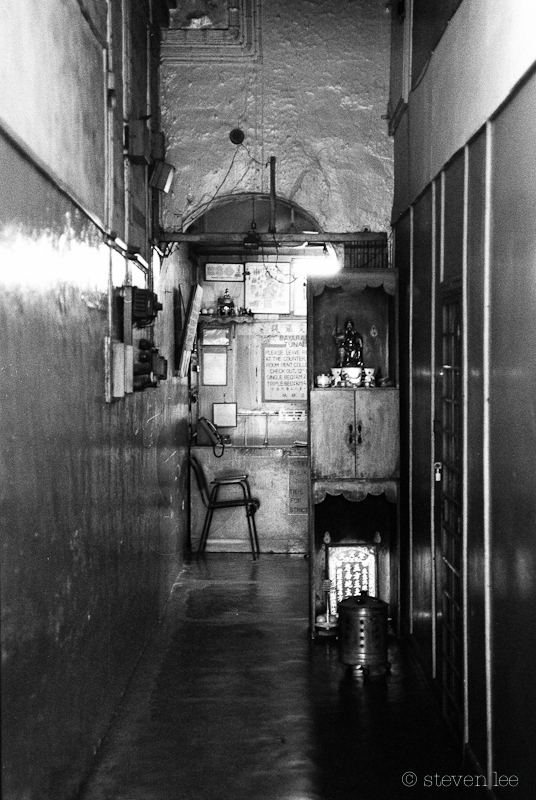 Reception, Hotel Leng Nam, Jalan Tun H S Lee 1999 © S Lee
Coming back to my original topic of this piece, street photography. I realise that for any serious project on the street, one must have an intention, and an executable one at that. Most photography done on the street are social documents. Even if you have a penchant for street furniture, street portraits, or making architectural studies, it is about making a document of the social conditions, the environment and situation which surrounds us. So, in most respects, it must include the ‘players.’ These are the people that live there, work there, and visitors. What are they doing? Why are they there? These are some questions that can assist in your approach.
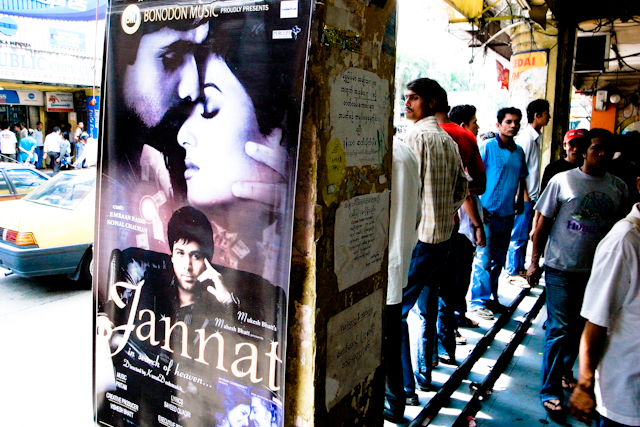 Bangladeshi immigrants hanging out in Leboh Pudu on a Sunday, Kuala Lumpur 2008 © S Lee
Today, I still photograph this area of Kuala Lumpur and make a point to head downtown whenever I visit Malaysia, making another documentation of images in colour, which is the medium I shoot nowadays. The combination of various cultures, mixing of local and immigrants, the ethnic-based stores and trinket stalls make it a colourful and fascinating place to photograph.

Nepalese gemstone traders, Petaling Street, Kuala Lumpur 2009 © S Lee
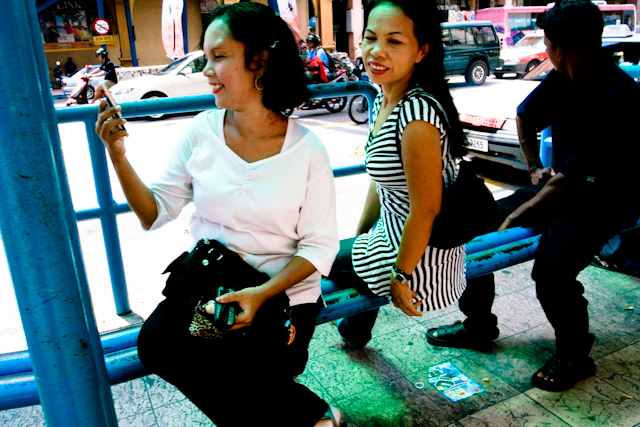 Filipinas waiting for a bus, Kota Raya, Kuala Lumpur 2008 © S Lee
10 years on and the landscape is changing. Old KL is now a haven for the immigrant population. Bangladeshis, Nepalese, Cambodian and Filipino workers have pretty much taken over the streets of Central KL, as the more affluent locals congregate towards the Golden Triangle, KLCC and MidValley. Socially speaking, it is interesting times. Weekends present the best time for street photography. Chinatown and its surrounding streets turn into Little Nepal. I like this. Its makes for a multinational city with soul, rather than a superficially glossed-over pristine bubble.
Note :

* Outside Looking In : Kuala Lumpur
I have some limited copies of this book available to anyone who wants one, you just need to drop by to a PJ address to collect it, complimentary. Email me at svllee@gmail.com
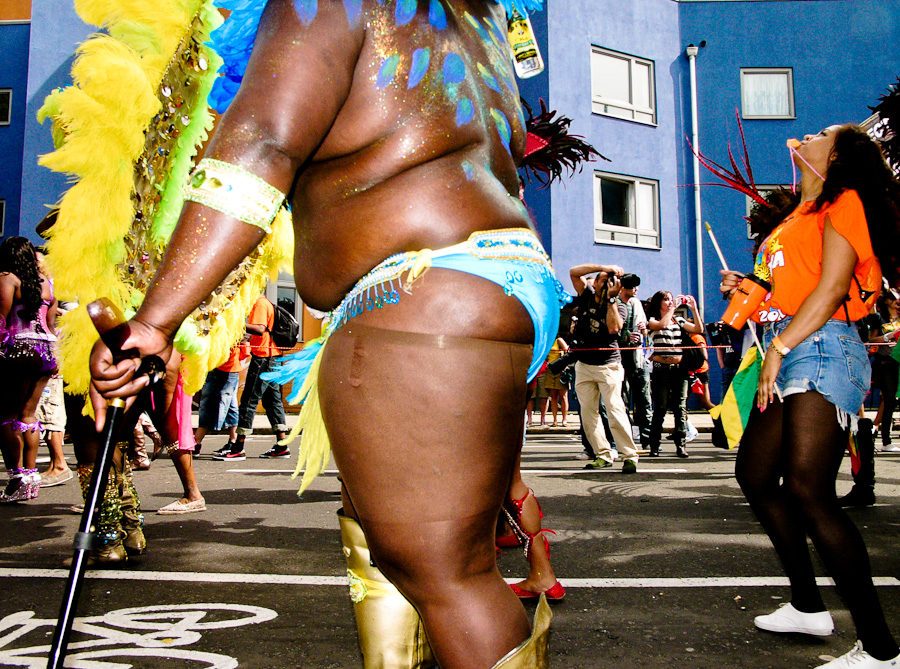
Met up with Revi, Kirsten and Malika this morning at 9:30am at Cafe Nero by Notting Hill Gate station and headed up to the pre-start area of the street parade, up by Kensal Road W10. Having attended the carnival for several years now, I still find it a great opportunity to photograph street portraits and scenes of performers real close, without any form of intrusion or barriers. The street performers and dancers always willingly oblige to have their photographs taken, without any reservations, and the music and dancing is always a spectacle to behold, not to mention the fantastic colourful and elaborate costumes which adorn some of them. So much effort has gone in to the design and manufacture of them, for months before the carnival. Here are some images from today. For more Carnival photos from previous years, please look here.
Enjoy!
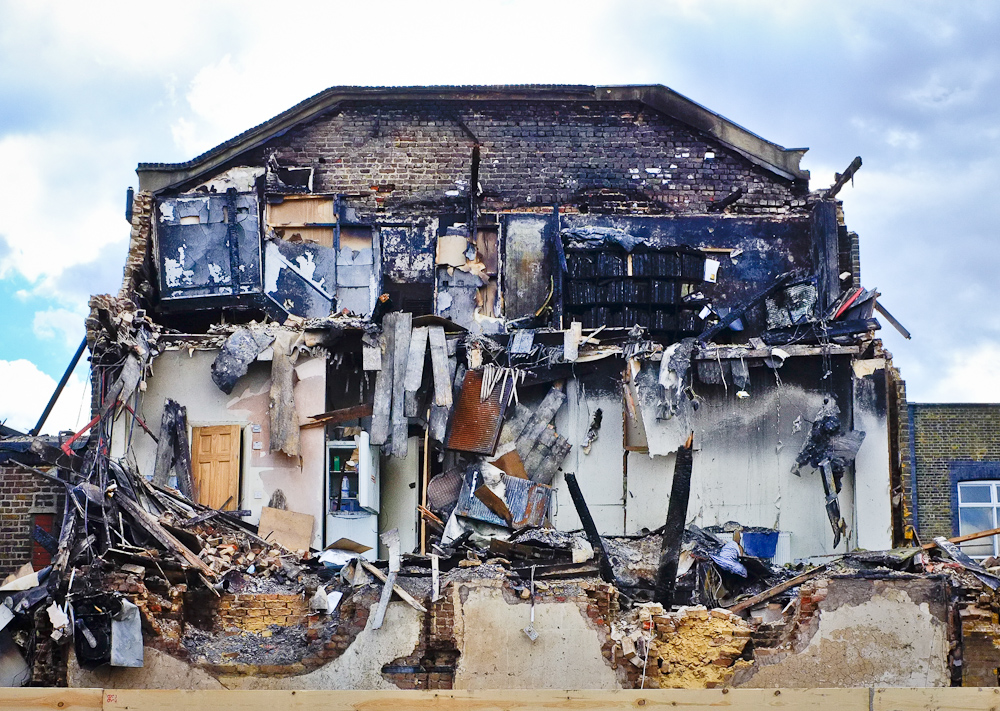

A week after the most violent and widespread riots in London and in the UK for over 25 years, I urged myself to go have a first hand look at the place where it all kicked off, that is Tottenham High Road, in north London. Last evening, I tossed and turned in bed, just willing myself to go check out the situation on the ground and meet some of the local traders and shopkeepers that had been affected. A little voice kept urging me to ‘take camera’ and ‘go shoot’ Tottenham one week after.
Monday morning, I sms’d Zarina, a video journo who runs Sojournposse.com and suggested the idea to her. We met up and tubed it up to Seven Sisters where we walked the half mile north towards Tottenham High Road. It is after all, over 1 week since the fires were lit and a sense of normalcy has returned to the streets. Without careful observation, one would not have guessed anything significant had happened. As we approached the flashpoint (the Police Station), we could see some shopfronts boarded up, some fire damaged was evident, black charred facades and melted signage. Many glass frontages had some damage but were left as they were. Almost all bus shelters had their glass sides broken, including telephone booths. Most local authority buildings like the youth centre, job centre and housing offices were completed burnt or seriously damaged and were closed. The road section where the double decker bus was set alight melted away and had just been resurfaced. The pub adjacent to the burning bus had all their windows panes melted due to the heat. Workmen were busy installing new glazing.
I, like so many, have read the hundreds of column inches of news that have been written about the riots in the press and online, listened to hours of news and radio coverage, debates, and discussed at length with friends about the causes, reasons, justifications of these horrific uprising of humans against humans. I had to experience it first hand. So far at least 5 people have died, hundreds have been made homeless, hundreds of stores looted, millions of pounds lost, families wrecked, over 2,500 rioters arrested, many charged and imprisoned, many buildings, cars and stores fire damaged and destroyed.
The riots spread from Tottenham across many parts if London, including Enfield, Croydon, Clapham, Wood Green, Notting Hill Gate, Kings Road, North End Road, Peckham, Ealing and many other spots, plus in other UK cities like Manchester, Birmingham, and Nottingham as well over several days. Of course, the causes will be debated ad naseum by politicians, the police, sociologists, celebrities, journalists, etc. None will the be the wiser.
It was as if an airborne virus has infected, spread and triggered off some people, and a temporary antidote had been found. There is still tension in the air that one could feel. It was surreal, as if walking in a fog.
Ask any Tottenham local.
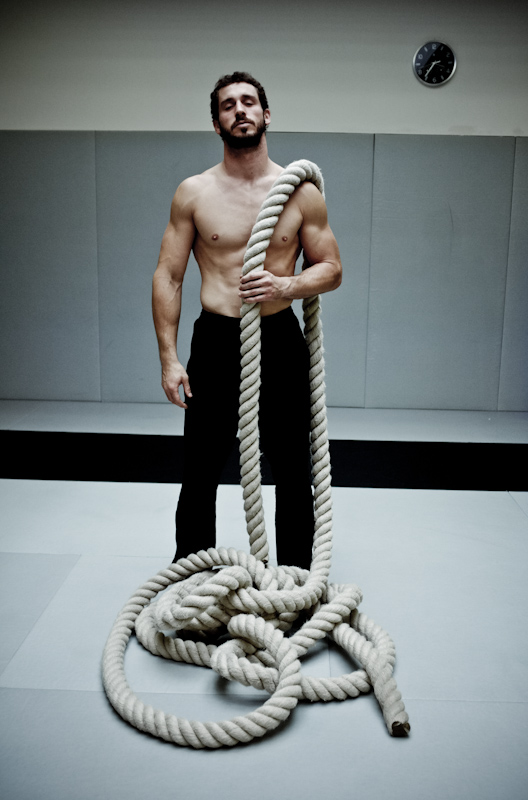
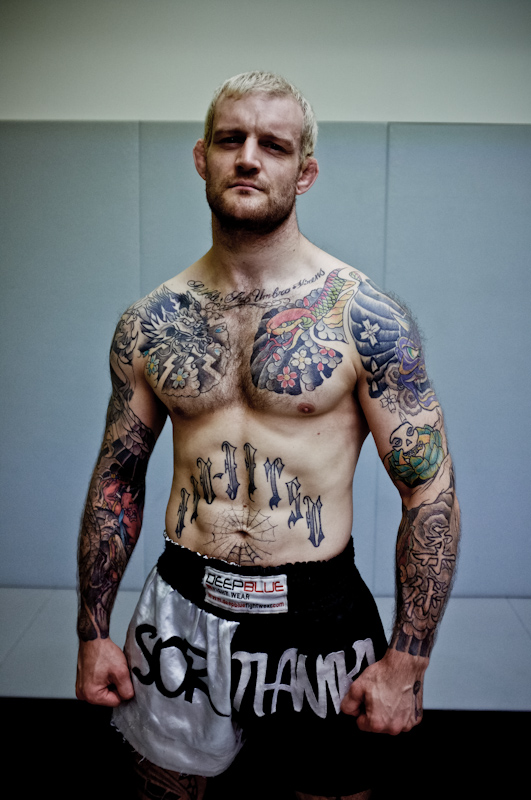 Pete Irving © Steven Lee
Urban Kings Gym is a new state of the art martial arts and boxing gym in the heart of Kings Cross. Opened about a year ago, the gym looks more like a lounge club than a typical ‘sweat n sawdust’ fight venue. Andy and I were invited to make some portraits and abstract studies of the staff and management team, which may end up as wall prints or on their website. Bunmi, our contact is running the therapy and massage outfit there and is pretty useful as a boxer too.
These are portrait from a series, which I made of Bruno, the Trainer Manager and Pete Irving who prides himself with his awesome tattoo motifs. He is the BJJ and MMA trainer.
Photographed with the Fuji X100 with the built-in ND filter at 640ISO.


In the movie ‘The Island’ (which played on the box this week), the high tech boat that Euan Macgregor’s ‘real’ character was building was called Renovatio (in Latin, meaning Total Rebirth) inspired me to work on a new series centred on antiques and objet d’art, which I have a great interest in. For me, inspiration may come from anywhere, and anything. Usually, a word or an action, or even a sign or symbol will spark something deeper and set of a chain reaction in my mind.
We shall see.


Finally, Summer weather has descended over the UK. For good is a hard thing to ask, perhaps for the next week at least. Please. It has been so wet and miserable over the last couple of weeks, I thought this year we are skipping Summer, and headed straight towards Autumn.

 explorenation.net ~ photography posts, workshops, writings and thoughts by Steven V-L Lee
You must be logged in to post a comment.